
About Us
The Architectural Heritage Centre is dedicated to the preservation, documentation, and promotion of architectural heritage. We serve as a resource hub for research, education, and community engagement, highlighting the cultural, historical, and social significance of the built environment. Through conservation initiatives, knowledge sharing, and advocacy, the Centre supports the protection of architectural heritage for present and future generations.
Ethnologists have studied the people of the country, linguists have concerned themselves with languages groupings, but until the School of Architecture and Building at the Papua New Guinea University of Technology initiated its surveys, no systematic work had been done to record the architectural styles of ceremonial and dwelling houses throughout the country.
The aim of “The Architectural Heritage Centre of Papua New Guinea” is to preserve the wealth of traditions, skills and talents displayed in the buildings built by the fathers, grandfathers and ancestors of the young people of present-day Papua New Guinea. The Centre will preserve knowledge of the remarkable diversity of architectural forms, astutely adapted to local conditions, using only a limited repertoire of available materials.
Of the Initiative to establish the Architectural Heritage Centre of Papua New Guinea, A previous Vice-Chancellor of the Papua New Guinea University of Technology has said, “This reflects PNG cultural conservation values, possess considerable intellectual and academic merit, and acknowledges the global judgement of PNG’s architectural heritage as being pure gold”.
Brief History
In 1979, a South Pacific Commission-UNESCO Symposium on “The Preservation of Traditional Living Art in Oceania” incorporated several proposals, including:
RECOMMENDATION 5: “Those Governments and administrations in the region (Oceania) be encouraged to establish proper technological facilities for the conservation of the arts of Oceania.”
This statement reflected a world-wide concern for the preservation and documentation of art forms rapidly changing and/or disappearing in many developing nations around the world.
There is large scale awakening of interest in the recording of the world’s many vernacular building traditions. This phenomenon is being stimulated, in part, by a recognition of the great beauty of traditional building and, in part, as a reaction to the gross depletion in the stock of the world’s architectural heritage. The world is being made poorer as each tradition dies out, a process of extinction which can be likened to the environmental degradation of the planet by diminishing the global gene pool.
Because of its ephemeral nature and the tremendous social and economic transformations taking place in the country, the traditional architecture of Papua New Guinea is under severe threat. Recognizing this situation, A Village Studies Program was initiated in the Department of Architecture and Building at the Papua New Guinea University of Technology in 1972 by the then Head of Department, Professor Neville Quarry. The concept was to survey and record the art and architecture of each of the 19 provinces of Papua New Guinea. Over the years many people have contributed to the Program, including Ms. Janet Grey and Messrs Gordon Holden, Ken Costigan, the late Jack Lowson, Rod Hull, Shogo Nishikawa, George Loupis and the current Head of Department Professor Rahim Milani. By far the greatest contribution has been made by Professor Wallace (Mac) Ruff and his late wife Ruth, who have collected a large amount of data on villages in Sepik, Sandaun and Gulf Provinces.
The collection of their work known as the Ruff Collection, covers a period from 1968-92 and comprises over 8000 black and white prints; 12000 black and white negatives; 900 color prints; 4500 color negatives; 10 hard-cover sketch books; 12 field notebooks (from 1968 to 1992); 80 large scale drawings; 1000 small scale drawings; and 400 abstract drawings.
It is important to realize that of the buildings recorded by Professor Ruff, 95% have disappeared without being replaced, leaving the Ruff Collection as the only recorded source of knowledge of these structures.
Sadly, due to lack of resources, very little of this work has been published and information collected has yet to be catalogued in a systematic way to make it accessible to the public and scholars. More importantly, much field work needs to be done to ensure all remaining examples of traditional architecture and oral information about the buildings are recorded before it is too late.
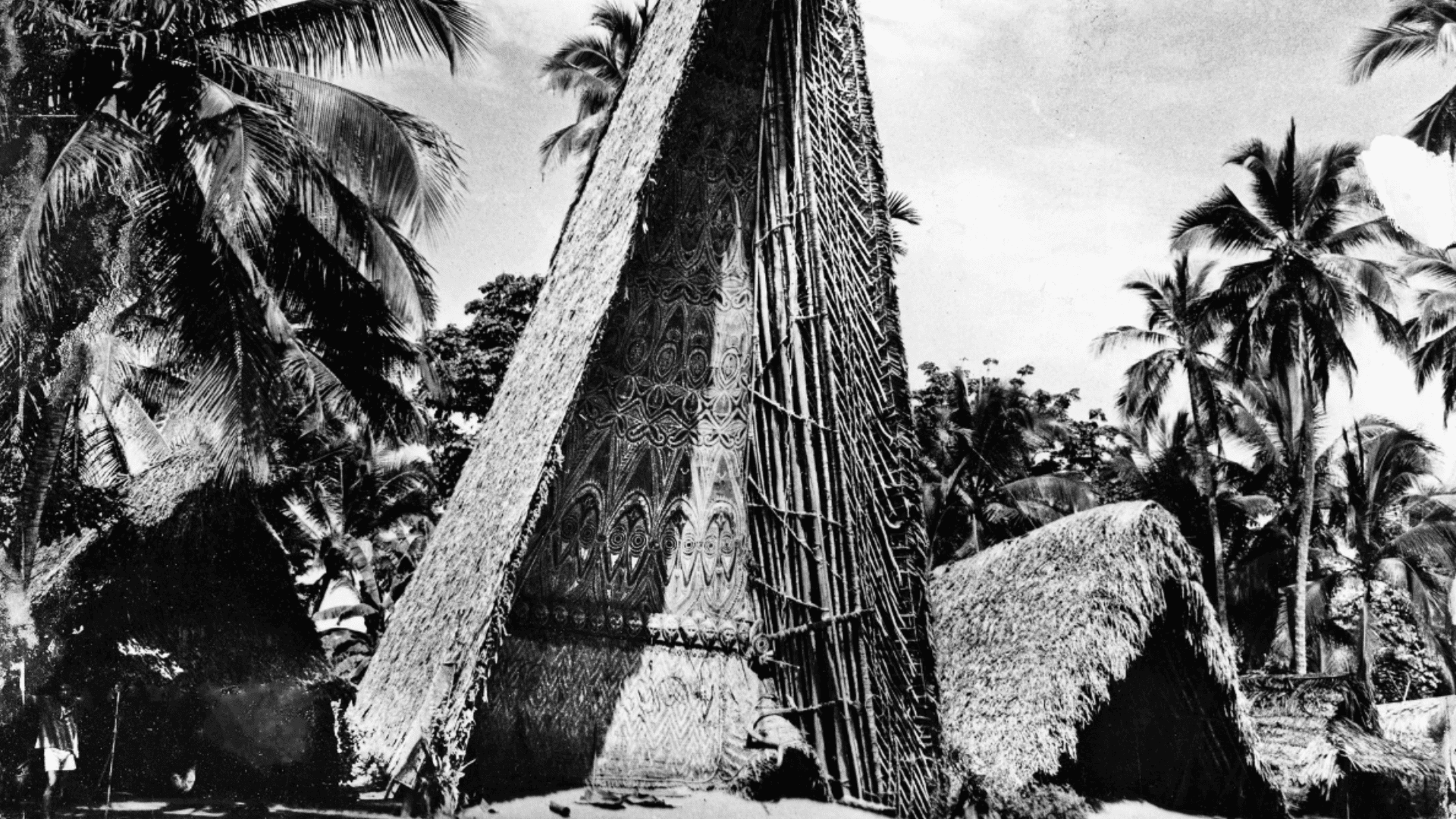
CEREMONIAL HOUSE OF TIMBUNKE VILLAGE, SEPIK RIVER, 1975. DRAWN BY THE LATE JACK LOWSON, DEPARTMENT OF ARCHITECTURE UNIVERSITY OF TECHNOLOGY 1976
Professor Wallace Ruff
Professor Wallace Ruff has a long and distinguished career in teaching and research. His teaching career started soon after he completed his studies in landscape architecture at the University of California, Berkley, in 1948. He has won numerous awards for his architectural and landscape designs. In 1974 he began his long association with the department of Architecture and Building at the PNG University of Technology.
The Ruff Collection was collected by Wallace and his late wife, Ruth, over twelve years of research and work in Papua New Guinea. Beginning in 1958, the Ruff’s used their summer breaks and sabbatical leaves to collect artefacts, photographs villages and ceremonial houses and conduct research in the villages of PNG.
Professor Ruff’s great concern is that the architectural heritage of his country will disappear as it has in other developing countries. To preserve this heritage Professor Ruff is giving of his knowledge, his vast collection of material and his time to establish “The Architectural Heritage Centre of Papua New Guinea.”
Mack Ruff’s Village Studies Project is a substantial collection of thousands of items including photographs, negatives, drawings, notes and text.
The Village Studies Project case studies documented after 1975 are housed in the Architectural Heritage Centre of Papua New Guinea, established by Professor Wallace M Ruff (known as Mack Ruff) who significantly expanded upon the earlier work.
Most of the pre Ruff early work is yet to be deposited with the collection. However until the missing work is developed, presented, published and critically reviewed, its contribution to Papua New Guinea architecture heritage remains largely untested.
Due to lack of resources very little of the work required to develop the Centre has been undertaken. Although a vast amount of material has been collected, the Centre has not had the funds to catalogue and archive the material. A permanent home for the Centre has been found in the Department of Architecture and Building for this purpose. Professor Ruff was personally meeting the cost of outfitting the Centre.
Since Professor Ruff’s untimely death, the incumbent Heads of the Department since continued these village study surveys with fourth and fifth year students, drawing traditional buildings and writing reports thus depositing such data into the Architecture Heritage Centre. The village studies projects carried out by students and staff of the department was seen as the best approach to fast track the collection of data on traditional buildings. The collection of data on the subject somewhat slowed down in recent years, due to frequent departure of certain interested academics from Papua New Guinea when their tenure end after every three years.
Establishment of Architectural Heritage Centre
When the Council of the Papua New Guinea University of Technology approved the establishment of the Heritage Centre in 1994, it superseded the Ruff Personal Collection. At the time of its inauguration, the Centre was seen as having a number of purposes as follow: “To establish a comprehensive collection of traditional buildings and settlement patterns of all cultural regions within Papua New Guinea and conserve this knowledge for future generations” (Ruff, 1994)
“To make information on traditional building culture of Papua New Guinea accessible locally and internationally through a number of methods seemingly outdated now in this digital age.” (Ruff, 1994).
The AHC now has its own constitution and board. It is entrusted with:
- archiving the records of the architectural heritages of Papua New Guinea
- undertaking recording and research work on those heritages
- promoting the awareness and understanding of the value of those heritages
The Architectural Heritage Centre of Papua New Guinea was established in 1994 as a research arm of the Department of Architecture and Building under the direction of a Board of Management. Its aim is to:
- accelerate and expand the range of research done
- to insure that the data collected, is properly catalogued
- to publish the results of research in monographs, books, or in CD format